Hand wash or tunnel wash: what each does to your clear coat
The way a car gets washed matters more to the paint than how often it gets washed.
October 16, 2026 · 4 min read
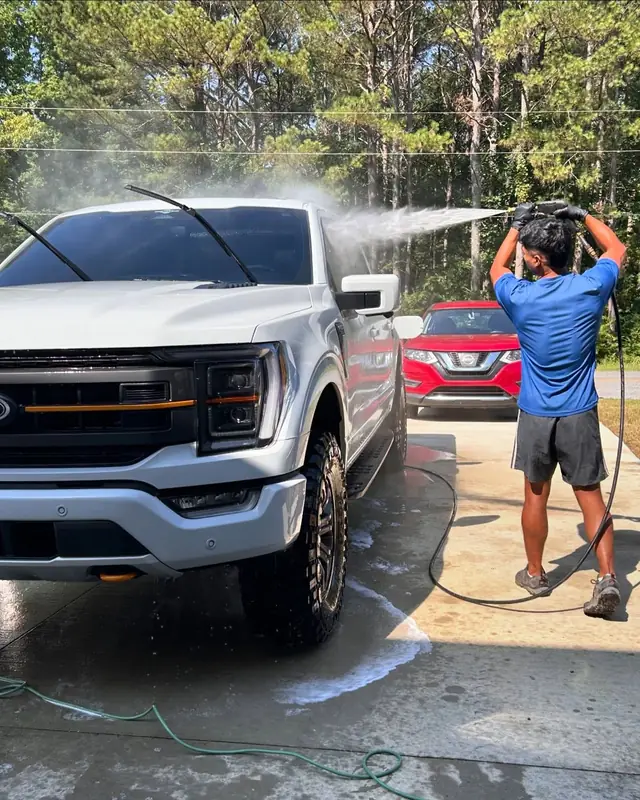
Every car on a Cullman County road has a thin layer of clear coat over its color, and that layer decides whether the paint looks deep and glossy or tired and hazy. Most people never think about it until they spot fine, circular scratches in the afternoon sun. Those marks usually come from how the car was washed, not from how often. Here's what's going on, and what to look for in a wash.
What your clear coat does for the car
Modern paint is built in layers. There's primer, then the color coat, then a clear coat on top. The clear coat is what you actually see when you look at your hood. It gives the paint its gloss, it shields the color underneath from sun and road grime, and it takes every single wash you ever give the vehicle.
It's also thinner than most people expect. It's strong enough for daily life, but it's a finish, not armor. Fine scratches in it don't mean the car is ruined. They do mean the surface is no longer perfectly smooth, and a rough surface scatters light instead of reflecting it cleanly. That's why scratched paint looks dull even when the car is spotless.
Where swirl marks come from
Swirl marks are thousands of tiny scratches, usually in circular or crisscross patterns, that show up best under direct sunlight or a bright garage light. They aren't caused by soap or water. They're caused by something hard being dragged across the paint.
That something is almost always grit. Road dust, sand, brake dust, and dried mud sit on every vehicle. When a brush, a towel, or a wash mitt moves across the paint, any particle caught in the material gets pressed against the clear coat and pulled along with it. The material itself is soft. The grit trapped in it is not. Each pass leaves a hairline scratch, and after enough washes those scratches add up to a visible haze.
What can happen in a tunnel wash
A typical tunnel wash moves your car along a track while spinning brushes, cloth strips, or foam rollers pass over it. The same material touches car after car, all day long. It may get rinsed between vehicles, but it's still picking up whatever the last truck brought in.
BMC's own comparison puts it plainly. A tunnel wash can leave swirl marks and scratches, it uses the same material on every car, and it takes time out of your schedule while you drive, wait, and do part of the work yourself. Some tunnels are touchless and skip the brush contact, though they rely on stronger cleaners and high-pressure water to loosen the dirt instead. Either way, you don't get to see what touched your paint.
How a hand wash protects the paint
A careful hand wash isn't magic. It's a set of habits aimed at one goal, which is keeping grit away from the clear coat. The details matter more than the brand of soap.
- Rinse the car first, so loose dirt and sand wash off before anything touches the paint.
- Pre-wash with a cleaner and let it loosen what's stuck, so less has to be scrubbed.
- Wash from the top down, and save the dirtiest lower panels and wheels for last.
- Use clean microfiber and swap it out often, instead of dragging one dirty mitt across the whole car.
- Rinse the mitt frequently so grit falls away from it instead of riding along.
- Dry with clean, soft towels, never a rough cloth or a towel that's been on the ground.
BMC says its hand detail changes microfiber and other supplies between vehicles, which is exactly the habit that keeps one truck's dirt off the next car's paint.
Six gallons versus fifty
Water use is the other half of BMC's comparison. According to BMC, a tunnel wash can use up to 50 gallons of water per vehicle, while a BMC hand detail uses about 6. That's a big gap, and it comes from method. A hand wash puts water where it's needed, wetting and rinsing panels on purpose. A tunnel runs high-volume sprays and rinses across the whole car every time, whether a panel needs it or not.
If you care about wasting less water, or you simply don't want a hose running in your driveway for an hour, that number is worth knowing. And because BMC's detailing units carry their own water and power, you don't have to set anything up.
Picking the right wash for your car
If your daily driver spends its life on gravel roads, a quick wash now and then won't cause anything dramatic. But if you've noticed swirl marks, or you care about how the paint looks on a newer vehicle, switch to a method that controls what touches the finish. Hand washing is slower, but it's gentler.
Already have swirls? They can be corrected, which we cover in another article on clay bars and paint correction. The important part is to stop adding new ones.
If you'd like your car hand washed at your home or workplace anywhere in Cullman County, call or text 256-297-3370 or book online.
Bet's Mobile Carwash, 256-297-3370
Call 256-297-3370More articles
What a clay bar and a 1-step paint correction actually do
Two steps that sound technical turn out to be simple once you see what each one removes.
Getting a family car back from crumbs, spills, sand and pet hair
A drive-through vacuum won't touch most of what kids, pets and weekends leave behind.